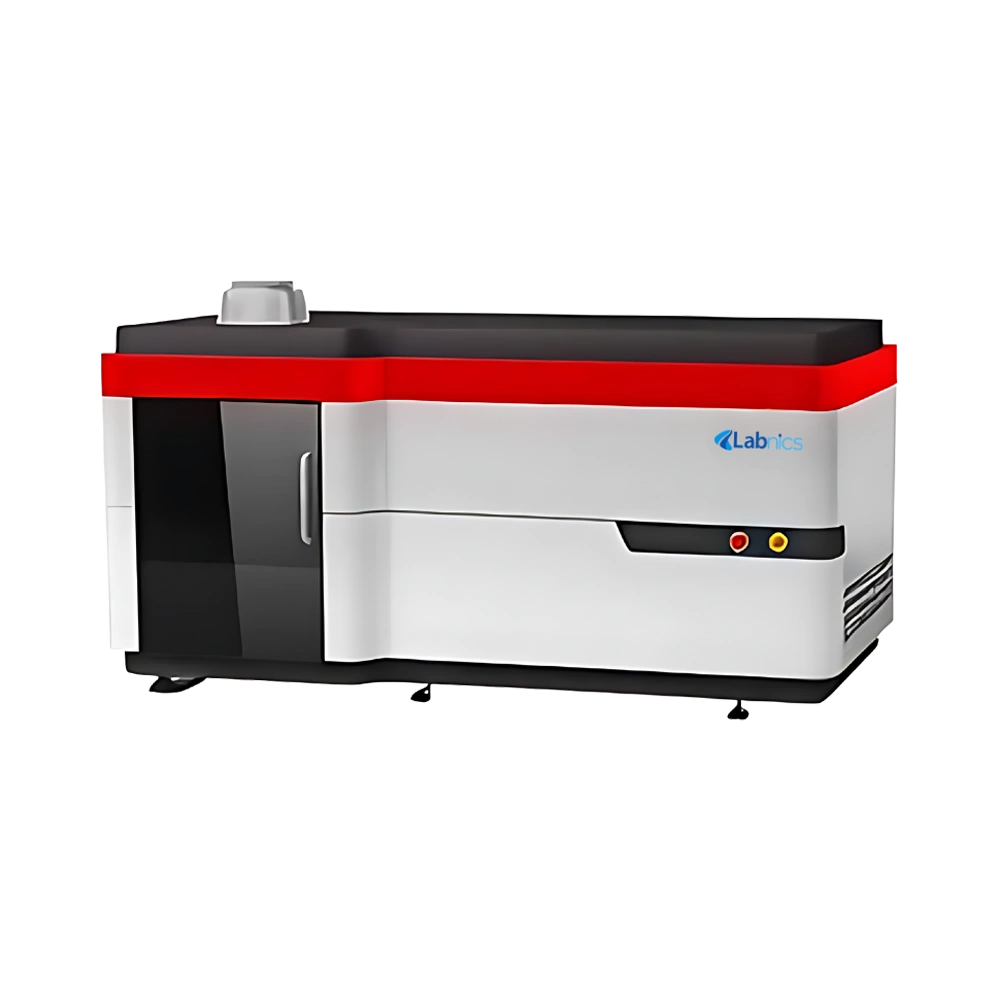
Inductively Coupled Plasma Emission Spectrometer NICP-103 offers a torque tube with three concentric channels and an outer diameter of 20 mm. Our advanced grating design delivers superior resolution for precise detection. It has an auto-matching RF circuit that ensures consistent plasma stability. Our coaxial nebulizer system constant temperature control within the optical chamber minimizes drift for accurate results. This high-stability detector improves sensitivity, ensuring reliable performance in laboratory conditions.
| Type |
Full Spectrum Direct Reading ICP-OES |
| Wavelength Range |
160 to1000 nm |
| RF Power Circuit |
Solid-state RF power supply with auto-matching |
| RF Frequency |
27.12 MHz ± 0.05% |
| Frequency Stability |
< 0.1% |
| Power Output Stability |
< 0.3% |
| Escaped RF Radiation |
30 cm away, Electric field E < 2 V/m |
| Sampling System |
Torque tube: Three concentric, OD 20 mm |
| Torch Working Coil |
Inner diameter: 25 mm |
| Nebulizer |
Coaxial type, Outer diameter 6 mm |
| Spray Chamber |
Double-barrel atomizing chamber, OD 34 mm |
| Gas Flow Control |
Plasma Argon: 100 to1000 L/h
Auxiliary Argon: 10 to 100 L/h
Carrier Argon: 10 to 100 L/h |
| Pressure Valve |
0 to 0.4 MPa |
| Cooling Water |
Temp: 20 to 25°C; Flow: > 5 L/min; Pressure: > 0.1 MPa |
| Grating |
Middle step grating, 52.67 lp/mm, 64° sparkle angle |
| Numerical Aperture |
Fs 8 |
| Resolution |
0.0065 nm at 200 nm |
| Astigmatism |
< 2 ppm at As 189.042 nm |
| Light Chamber |
Constant temperature: 35 ± 0.1°C; Nitrogen purging: 1.8 to 3.8 L/min |
| Detector |
27.6 mm × 27.6 mm, 1024 × 1024 detection units |
| Reading Mode |
NDRO, FF, RAI |
| Power Consumption |
800 W to 1500 W |
Inductively Coupled Plasma Emission Spectrometer NICP-103 used for high-precision multi-element analysis in complex matrices through advanced optical emission technology. It is applied in environmental testing, petrochemical analysis, metallurgical labs, pharmaceutical research, and quality control sectors.
FAQ for Inductively Coupled Plasma Emission Spectrometer NICP-103
1: How does the nitrogen-purged optical chamber improve performance in the Inductively Coupled Plasma Emission Spectrometer NICP-103?
The nitrogen-purged design in Inductively Coupled Plasma Emission Spectrometer NICP-103 minimizes interference from moisture and oxygen, maintaining optical stability and enhancing sensitivity for precise elemental detection.
2: Why is auto-matching RF technology important in the Inductively Coupled Plasma Emission Spectrometer NICP-103?
Auto-matching RF technology in Inductively Coupled Plasma Emission Spectrometer NICP-103 ensures consistent power delivery to maintain plasma stability, reducing downtime and improving accuracy during prolonged analytical sessions.
3: What advantage does the full-spectrum direct reading offer in the Inductively Coupled Plasma Emission Spectrometer NICP-103?
Full-spectrum reading in Inductively Coupled Plasma Emission Spectrometer NICP-103 allows simultaneous detection of multiple elements, saving time and ensuring comprehensive analysis with high accuracy in a single run.
4: How does constant temperature control affect the results in the Inductively Coupled Plasma Emission Spectrometer NICP-103?
Inductively Coupled Plasma Emission Spectrometer NICP-103, maintaining a stable optical chamber temperature (35 ± 0.1°C), prevents wavelength drift and ensures reliable performance for both routine and advanced analyses.
5: What are the benefits of multiple reading modes like NDRO and RAI in Inductively Coupled Plasma Emission Spectrometer NICP-103?
Non-destructive and flexible reading options in Inductively Coupled Plasma Emission Spectrometer NICP-103 enhance data integrity, reduce sample loss, and improve overall operational flexibility for different analytical workflows.