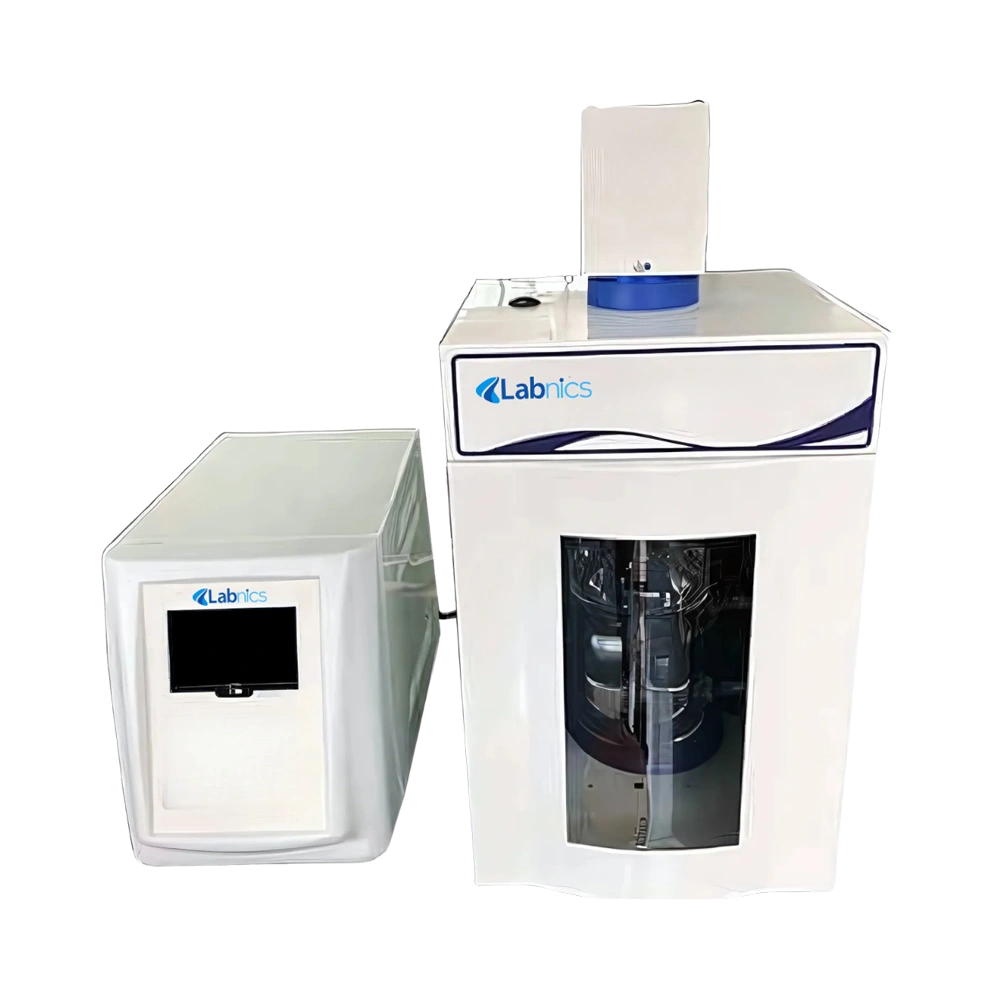
Ultrasonic Homogenizer NUH-200 offers a disruption capacity of 0.1 to 250 ml, accommodating different sample volumes. This homogenizer features a standard Φ6 mm horn for effective ultrasonic processing. Our unit operates with stable ultrasonic energy for consistent performance. It includes a 4.3-inch TFT touchscreen, allowing touch control for clear parameter display. It delivers flexible and efficient operation, ensuring reliable results.
Ultrasonic Homogenizer NUH-200 is used for efficient cell disruption, mixing, and extraction. It is used in biology, chemistry, pharmaceuticals, food processing, and environmental science.
FAQ for Ultrasonic Homogenizer NUH-200
1: What is the disruption capacity of the Ultrasonic Homogenizer NUH-200?
The Ultrasonic Homogenizer NUH-200 supports a disruption capacity of 0.1 to 250 mL, allowing flexibility for both small and moderate sample volumes. It is suitable for applications like cell lysis, emulsification, and dispersion across biological, chemical, and environmental fields.
2: Why does the Ultrasonic Homogenizer come with a standard ?6 mm horn?
The standard ?6 mm horn provides efficient ultrasonic energy transmission for medium-volume samples. It ensures reliable performance for routine tasks such as cell disruption and nanoparticle dispersion in various research environments.
3: Can I use different horn sizes with this homogenizer?
Yes, the Ultrasonic Homogenizer NUH-200 supports optional horns of ?2, ?3, ?8, and ?10 mm. This flexibility allows users to optimize energy output based on sample volume and sensitivity, improving control and processing results.
4: Does the homogenizer allow touchscreen control for parameter adjustment?
Yes, it features a 4.3-inch TFT touchscreen for intuitive control and monitoring. The interface displays real-time parameters like power, time, and frequency, helping ensure user-friendly and precise operation.
5: How does the advanced protection system work in this homogenizer?
Our homogenizer includes a built-in system that detects overheating, overloading, or abnormal function. It automatically shuts down when needed to protect internal components and ensure user safety during operation.