

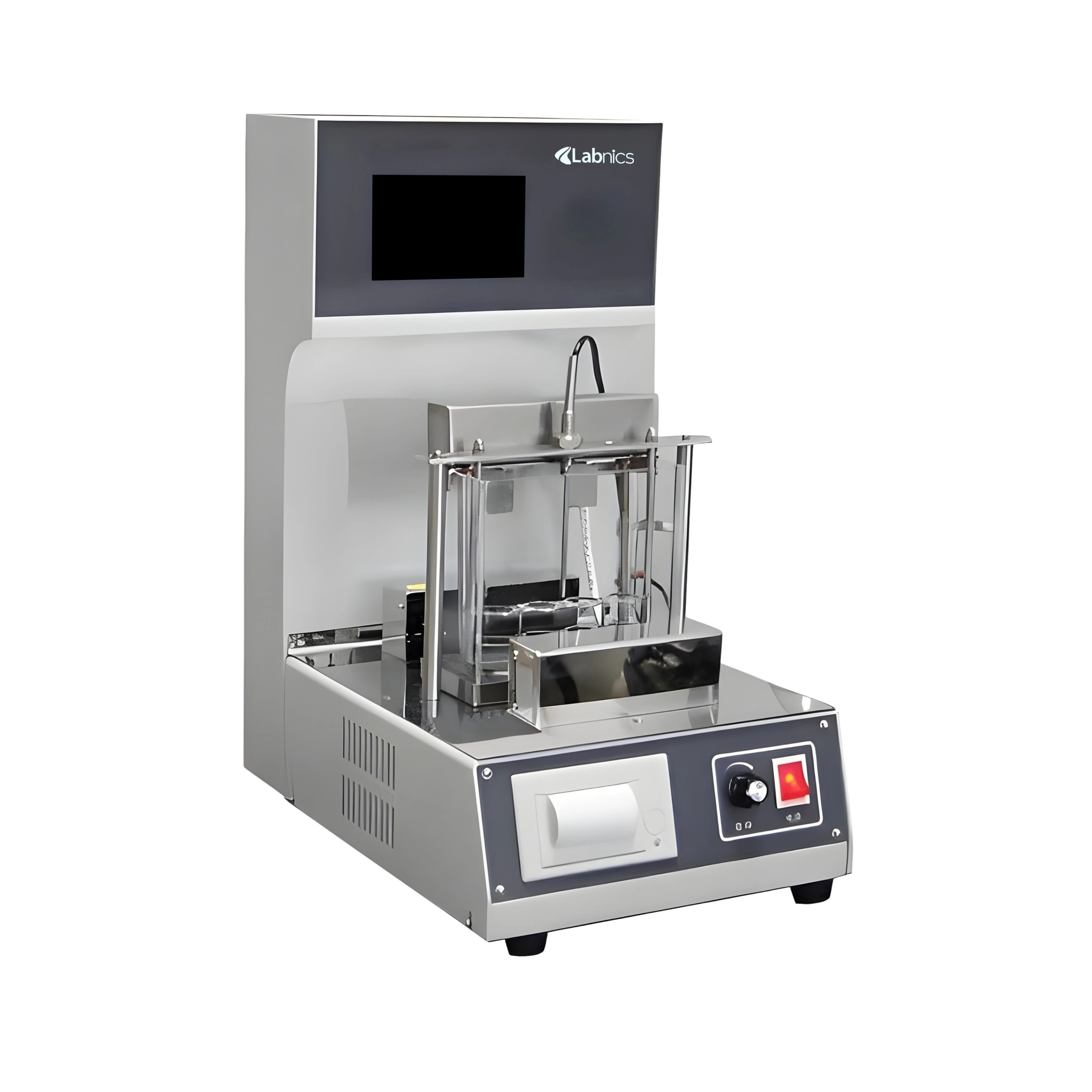
Automatic Softening Point Tester NAST-100 offers precise measurement with a temperature resolution of 0.1 ℃ and a large 900 mL beaker capacity. It features a stable automatic heating system, ensuring consistent softening point determination. Our electromagnetic stirrer allows adjustable speeds for uniform mixing. This touch LCD screen with printer output provides real-time results and data storage. It is designed with communication ensuring seamless connectivity for modern laboratory setups.
$7,350.00
| Measurement range | 32 ℃ to 160 ℃ |
| Ambient temperature | 15℃ to 35℃ |
| Temperature resolution | 0.1 ℃ |
| Beaker volume | 900 ml |
| Relative humidity | ≤85% |
| Heating power | 600 W |
| Total power consumption | 700 W |
| Dimensions (L × W × H) | 400 × 300 × 490mm |
| Packaging Dimension | 560 × 440 × 660mm |
| Net weight | 22 Kg |
| Gross weight | 28 Kg |
Laser detection system
Excellent repeatability
High reproducibility
Integrated printer output
Compact design
Automatic Softening Point Tester NAST-100 is used to determine the softening point of materials such as bitumen, asphalt, and resins for quality and performance evaluation. It is widely applied in construction materials laboratories, chemical industries, and research institutions.
1: What is the beaker capacity of the Automatic Softening Point Tester NAST-100?
The Automatic Softening Point Tester NAST-100 is equipped with a 900 mL beaker, providing sufficient volume for conducting accurate softening point tests in diverse material samples.
2: How precise is the temperature control in this Automatic Softening Point Tester NAST-100?
Automatic Softening Point Tester NAST-100 offers a temperature resolution of 0.1 ? and automatically adjusts the heating rate to (5 ± 0.5) ?/min after three minutes, ensuring stable and reliable results.
3: Can two samples be tested simultaneously in the Automatic Softening Point Tester NAST-100?
Yes, the Automatic Softening Point Tester NAST-100 is designed for dual-sample testing, increasing efficiency and reducing testing time for laboratory operations.
4: What type of interface does the tester support for data communication in the Automatic Softening Point Tester NAST-100?
The Automatic Softening Point Tester NAST-100 includes an RS-232C interface, allowing smooth data transfer and compatibility with laboratory software for advanced analysis.
5: How are test results displayed and recorded in the Automatic Softening Point Tester NAST-100?
Automatic Softening Point Tester NAST-100 results are displayed on a color touch LCD screen, and the integrated printer allows direct printing of test data for accurate record-keeping.
6: What is the purpose of a softening point tester?
A softening point tester is used to determine the temperature at which materials like bitumen, resins, and polymers transition from a solid to a softened state under controlled conditions.
7: In which industries are softening point testers commonly used?
Softening Point Testers are widely used in construction material testing, road engineering, chemical industries, and research laboratories to evaluate the thermal properties of different materials.
8: What types of materials can be tested using a softening point tester?
These Softening Point Testers can test asphalt, bitumen, resins, waxes, polymers, and other thermoplastic materials that require performance evaluation under heat.
9: Why is softening point testing important in road construction?
In road construction, softening point testing helps determine the temperature resistance of bitumen and asphalt, ensuring durability, stability, and quality of pavements under varying climatic conditions.