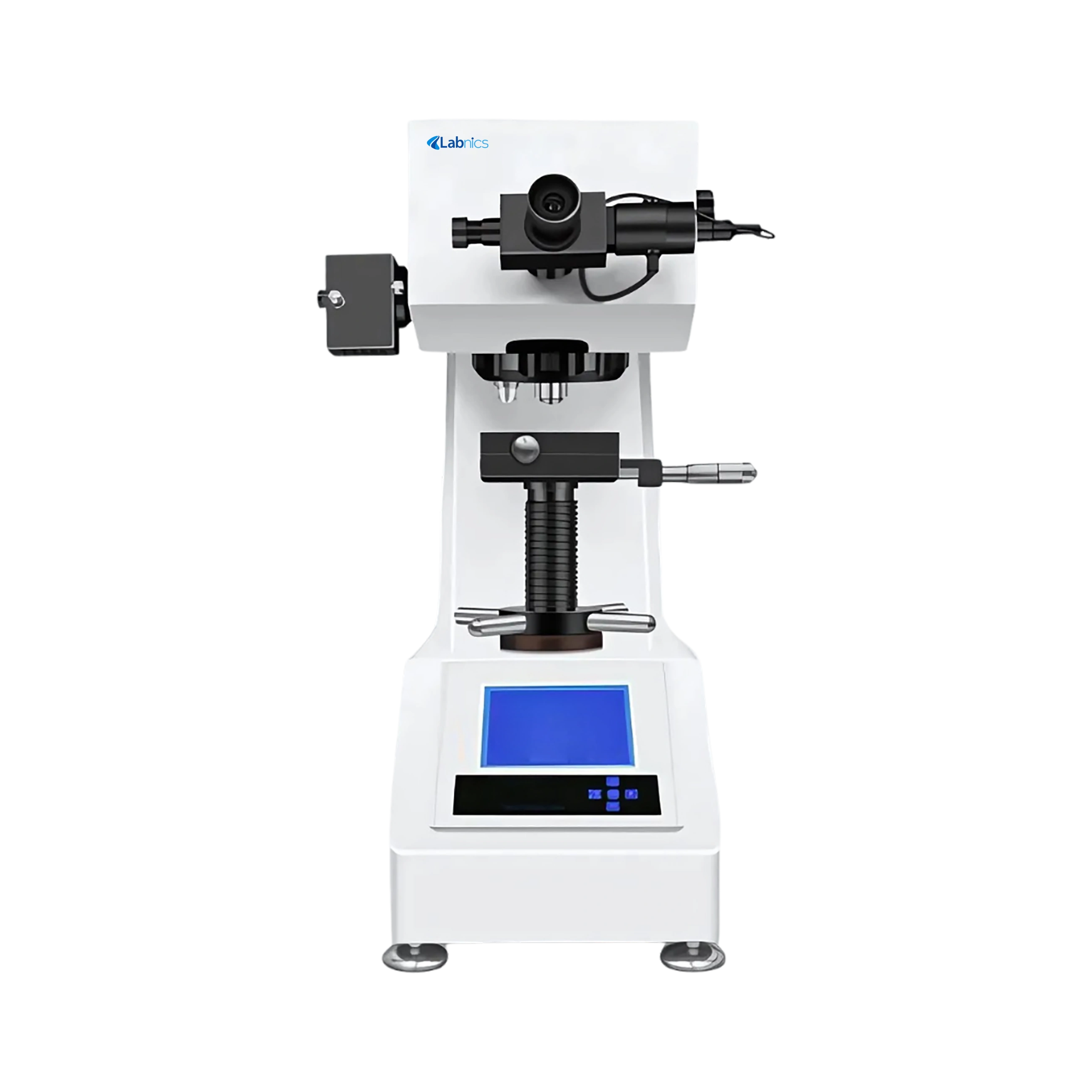
Digital Vickers Hardness Tester NDVHT-100 used to determine the hardness of metals and alloys with high accuracy and repeatability. It is widely applied in research laboratories, metallurgical industries, production quality control, and educational institutions for detailed hardness analysis.
FAQ for Digital Vickers Hardness Tester NDVHT-100
1: What is the test force range of the Digital Vickers Hardness Tester NDVHT-100?
The Digital Vickers Hardness Tester NDVHT-100 supports a test force range from 0.3 kgf to 10 kgf, making it suitable for analyzing a wide variety of metallic and alloy samples with varying hardness levels. This ensures flexibility across research, educational, and industrial applications.
2: Can the magnification be adjusted during testing in the Digital Vickers Hardness Tester NDVHT-100?
Yes, the Digital Vickers Hardness Tester NDVHT-100 provides dual magnification options of 100× and 400×. This allows operators to observe both broad surface characteristics and fine indentation details for more precise and reliable measurements.
3: How accurate are the readings are in the Digital Vickers Hardness Tester NDVHT-100?
With a resolution of up to 0.0625 ?m, the Digital Vickers Hardness Tester NDVHT-100 provides highly accurate and repeatable hardness measurements. This high resolution is ideal for detailed quality control and research analysis that demands precision.
4: Where is this Digital Vickers Hardness Tester NDVHT-100 typically used?
Digital Vickers Hardness Tester NDVHT-100 is widely used in metallurgical plants, research laboratories, educational institutions, and production quality departments. Its stable platform and automatic operation make it ideal for both routine quality control and advanced material analysis.
5: Is the shifting between objective and indenter manual or automatic?
The Digital Vickers Hardness Tester NDVHT-100 offers both manual and automatic shifting between the objective and indenter. This dual option ensures operational convenience while maintaining testing accuracy and reducing user fatigue during long testing sequences.
6: What is the main advantage of using a Digital Vickers Hardness Tester over a manual one?
Digital Vickers Hardness Testers offer automated load application, digital measurement, and data storage capabilities. This enhances accuracy and reduces human error during hardness testing.
7: Can Digital Vickers Testers perform both HV and HK scale measurements?
Yes, many of Digital Vickers Hardness Testers models support both Vickers (HV) and Knoop (HK) scales. With the appropriate indenter, they are ideal for testing materials with varied hardness and thin coatings.
8: How accurate is the measurement of indentation in Digital Vickers Hardness Testers?
The digital optical systems used in Digital Vickers Hardness Testers typically have a resolution as fine as 0.01 ?m, allowing precise measurement of even the smallest indentations.
9: Are Digital Vickers Testers suitable for high-volume testing?
Absolutely. Digital Vickers Hardness Testers, with programmable testing sequences and motorized stages, they streamline repetitive measurements for high-throughput testing.
10: What materials can be tested using Digital Vickers Hardness Testers?
Digital Vickers Hardness Testers can test a wide range of materials including steel, alloys, ceramics, composites, coatings, and even soft metals, making them versatile for industrial and research purposes.