| Temperature range |
Room temperature to 1250°C |
| Temperature resolution |
0.01℃ |
| Temperature fluctuation |
±0.01℃ |
| Heating rate |
0.1 to 100℃/min |
| Measurement range of the balance |
0.01mg to 5g |
| Quality resolution |
0.01mg |
| Constant temperature time |
0 to 500min |
| Cooling time |
30min |
| Toggle rate |
16.6Hz |
| Sample rate |
0.05 to 10Hz Programmable settings |
| Experimental mode |
FTC and STC can be set arbitrarily |
| Program temperature control |
Flexible setting of 12-stage temperature control throughout the entire stage |
| Temperature control method |
Heating, constant temperature, cooling |
| No. of scans |
The number of cyclic scans can be set up to 9999 times, and the data is automatically saved |
| Instrument calibration |
Both the lower computer and the upper computer have a multi-point temperature correction function |
| Atmosphere control |
Two atmospheres can be freely set, and the instrument automatically switches |
| Display mode |
24-bit color 7-inch LCD touch screen display |
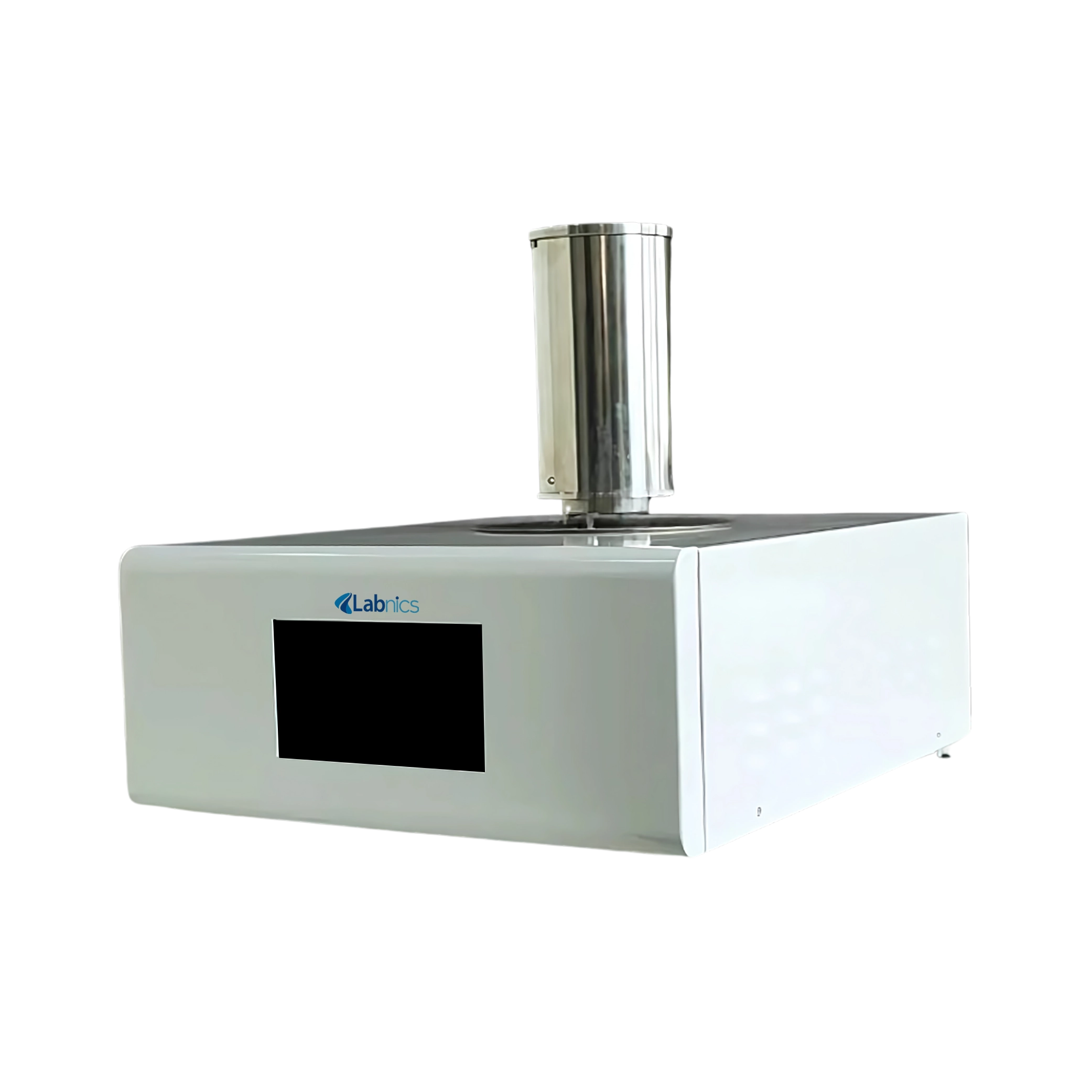
Thermogravimetric Analyzer NTGA-100 is used to determine thermal stability, decomposition patterns, and material composition through precise mass change measurement under varying temperatures. It is applied in industries like polymers, pharmaceuticals, coatings, metals, and composites for research, quality control, and process development.
FAQ for Thermogravimetric Analyzer NTGA-100
1: Can the Thermogravimetric Analyzer NTGA-100 handle both mass loss and gain during analysis?
Yes, the Thermogravimetric Analyzer supports both mass loss and gain analysis, making it ideal for studying adsorption, decomposition, and reaction processes. This dual capability enhances its value in advanced thermal research.
2: How is temperature stability maintained during testing?
The Thermogravimetric Analyzer includes a constant temperature water bath and a closed ceramic insulation furnace body for improved thermal stability. This setup ensures a steady environment, minimizing noise in the measurement data.
3: Is the Thermogravimetric Analyzer NTGA-100 easy to operate and monitor?
Absolutely. The Thermogravimetric Analyzer comes with a 7-inch 24-bit full-color LCD touch screen that displays real-time data and instrument status. The user interface is intuitive, making operation straightforward even for new users.
4: Does the Thermogravimetric Analyzer NTGA-100 support data storage and export?
Yes, the Thermogravimetric Analyzer automatically saves data from each cycle, which can be accessed or exported for further analysis. This ensures all experimental data is securely stored and easy to review.
5: Is maintenance and calibration easy to manage?
The modular furnace design allows for easy maintenance and upgrades. Both upper and lower control systems support multi-point temperature correction, ensuring long-term accuracy and reliability.
6: What is the Labnics Thermogravimetric Analyzer used for?
The Thermogravimetric Analyzer is used to study how materials lose or gain weight when subjected to changing temperatures. It helps determine thermal stability, composition, and moisture levels in various samples. This makes it suitable for applications in research, quality control, and material development.
7: Is the heating process consistent and controlled?
The built-in furnace ensures stable and uniform heating across the entire testing process. Controlled temperature ramps lead to accurate and repeatable thermal data. This consistency improves the reliability of results for sensitive materials.
8: Is maintenance difficult or time-consuming?
Maintenance is simple and does not require frequent intervention. Basic upkeep includes cleaning and periodic calibration, both of which are easy to perform. The Thermogravimetric Analyzer is built for long-term, dependable use with minimal downtime.