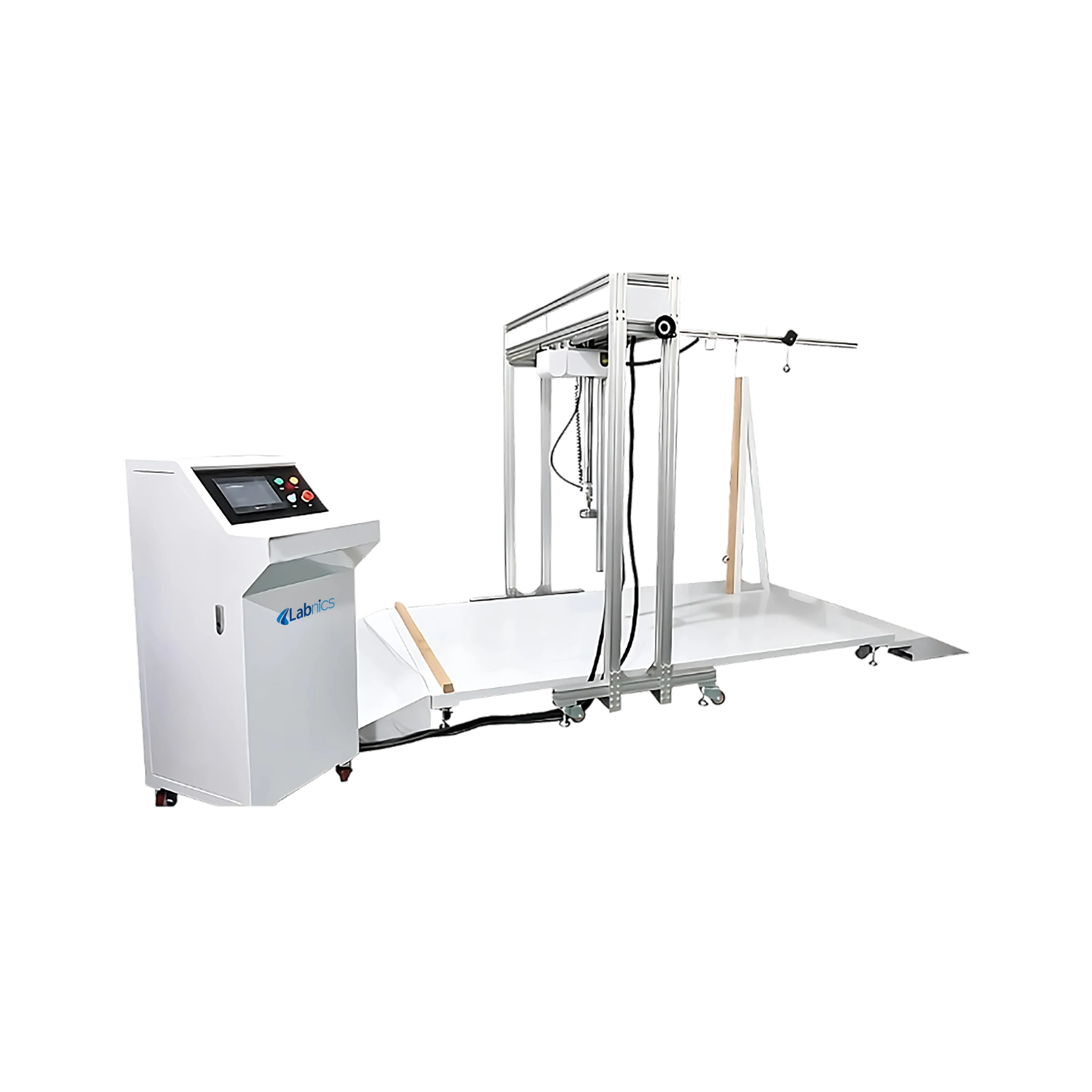
Rough Handling and Threshold Impact Tester NHTT-100 is used in impacts such as step collisions, threshold hits, and door frame bumps during transportation or operational use. It is commonly applied in laboratories for testing the durability of wheeled equipment, packaging.
FAQ for Rough Handling and Threshold Impact Tester NHTT-100
1: What types of products can be tested with Rough Handling and Threshold Impact Tester NHTT-100?
It is suitable for wheeled instruments, carts, mobile devices, or equipment that may experience handling or transport impacts.
2: Can the speed and stroke be customized for different test scenarios in NHTT-100?
Yes, test speed (up to 0.85 m/s) and stroke (up to 3600 mm) are fully programmable via the touchscreen interface.
3: How does it simulate real-world handling conditions?
It performs repeatable tests like threshold bumps, step climbs/drops, and door frame collisions to mimic operational roughness.
4: Is the Rough Handling and Threshold Impact Tester NHTT-100 safe for lab use?
Yes, NHTT-100 includes safety guardrails and operates in controlled lab environments at 5–40?°C, low dust, no EM interference.
5: Can the test station be customized for different specimen sizes?
Absolutely, the platform and clamping system can be customized to fit varying product dimensions and caster layouts.
6: Why is material testing important?
Material testing is crucial for determining whether materials can withstand operational conditions, reduce the risk of failure and ensure product reliability.
7: Where are Material Testing Machines commonly used?
They are widely used in research labs, manufacturing units, automotive, aerospace, and construction industries for quality control and R&D.
8: What types of tests can a Material Testing Machine perform?
It can perform tensile, compression, hardness, fatigue, impact, and flexibility tests depending on the model and configuration.
9: How does a Material Testing Machines improve product quality?
By accurately measuring material properties, it helps manufacturers ensure compliance with standards, reduce defects, and improve durability and performance.