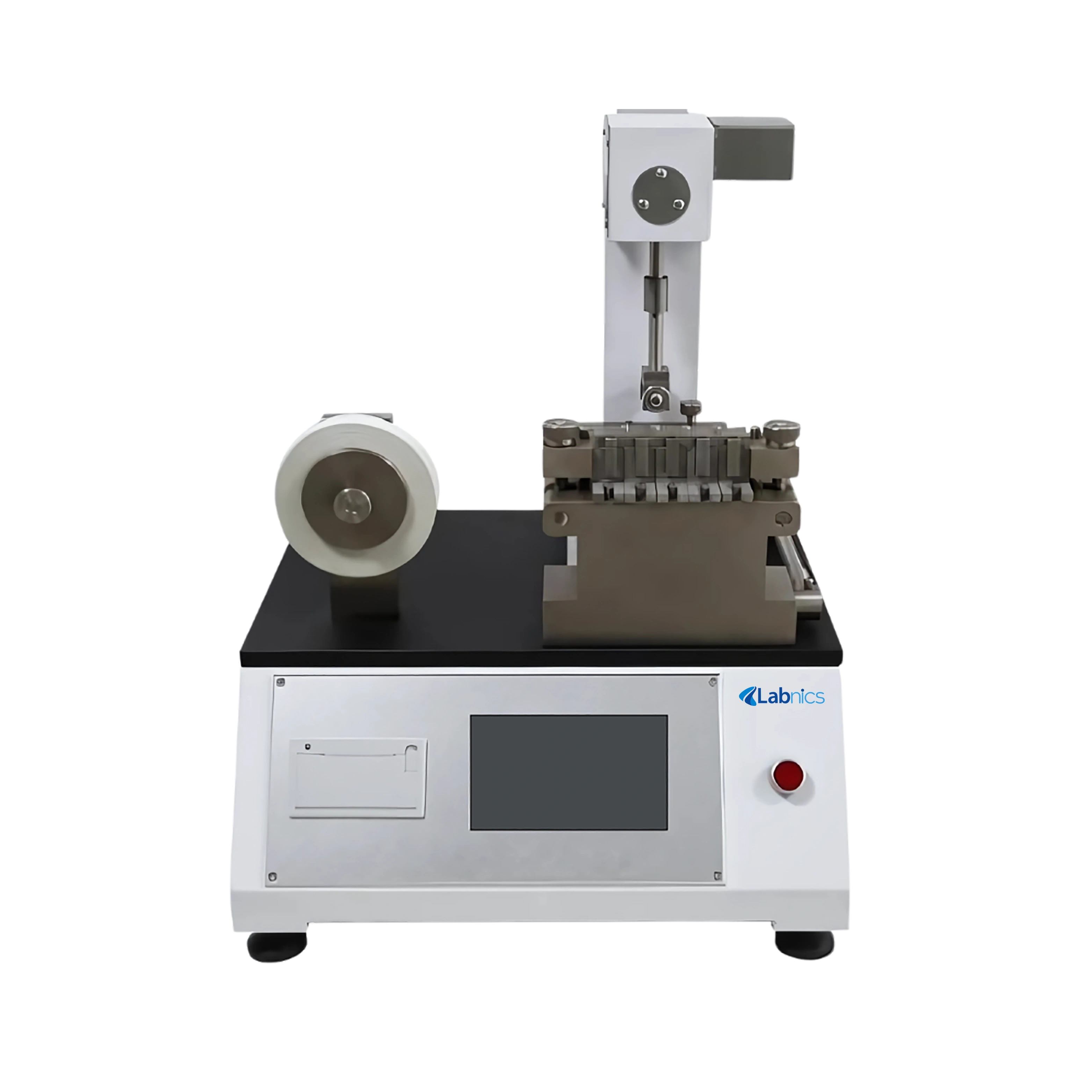
Digital Internal Plybond Tester NDPT-100 used to evaluate the internal bonding strength of paperboard by measuring the energy absorbed during a controlled impact. It is widely used in paper mills, packaging research labs, and quality control departments of board manufacturers.
FAQ for Digital Internal Plybond Tester NDPT-100
1: How many samples can be tested at once in the Digital Internal Plybond Tester NDPT-100?
The Digital Internal Plybond Tester NDPT-100 allows simultaneous testing of up to five paperboard samples, significantly reducing overall testing time and improving throughput in high-volume testing environments.
2: What units does the Digital Internal Plybond Tester NDPT-100 support for measurement?
Digital Internal Plybond Tester NDPT-100 supports J/m², kg/cm, and N/m, allowing you to choose the most appropriate unit depending on regional standards or internal lab preferences.
3: What makes this Digital Internal Plybond Tester NDPT-100 suitable for research labs?
Digital Internal Plybond Tester NDPT-100 has microcomputer-controlled operation, automated result processing, and high-resolution accuracy (0.001 lbf/in²) make it suitable for detailed research analysis and precise quality control.
4: Can the clamping force be adjusted manually in Digital Internal Plybond Tester NDPT-100?
Digital Internal Plybond Tester NDPT-100 has a glue pressing that is hydraulically controlled and fully adjustable, enabling customized pressure settings up to 400 N for different sample types or testing conditions.
5: Is the printer built-in and easy to maintain in the Digital Internal Plybond Tester NDPT-100?
Yes, the Digital Internal Plybond Tester NDPT-100 uses a modular type printer that is easy to install, service, or replace. This ensures reliable test result printing without extended downtime or technical assistance.
6: Why is material testing important?
Material testing is crucial for determining whether materials can withstand operational conditions, reduce the risk of failure and ensure product reliability.
7: Where are Material Testing Machines commonly used?
They are widely used in research labs, manufacturing units, automotive, aerospace, and construction industries for quality control and R&D.
8: What types of tests can a Material Testing Machine perform?
It can perform tensile, compression, hardness, fatigue, impact, and flexibility tests depending on the model and configuration.
9: How does a Material Testing Machines improve product quality?
By accurately measuring material properties, it helps manufacturers ensure compliance with standards, reduce defects, and improve durability and performance.