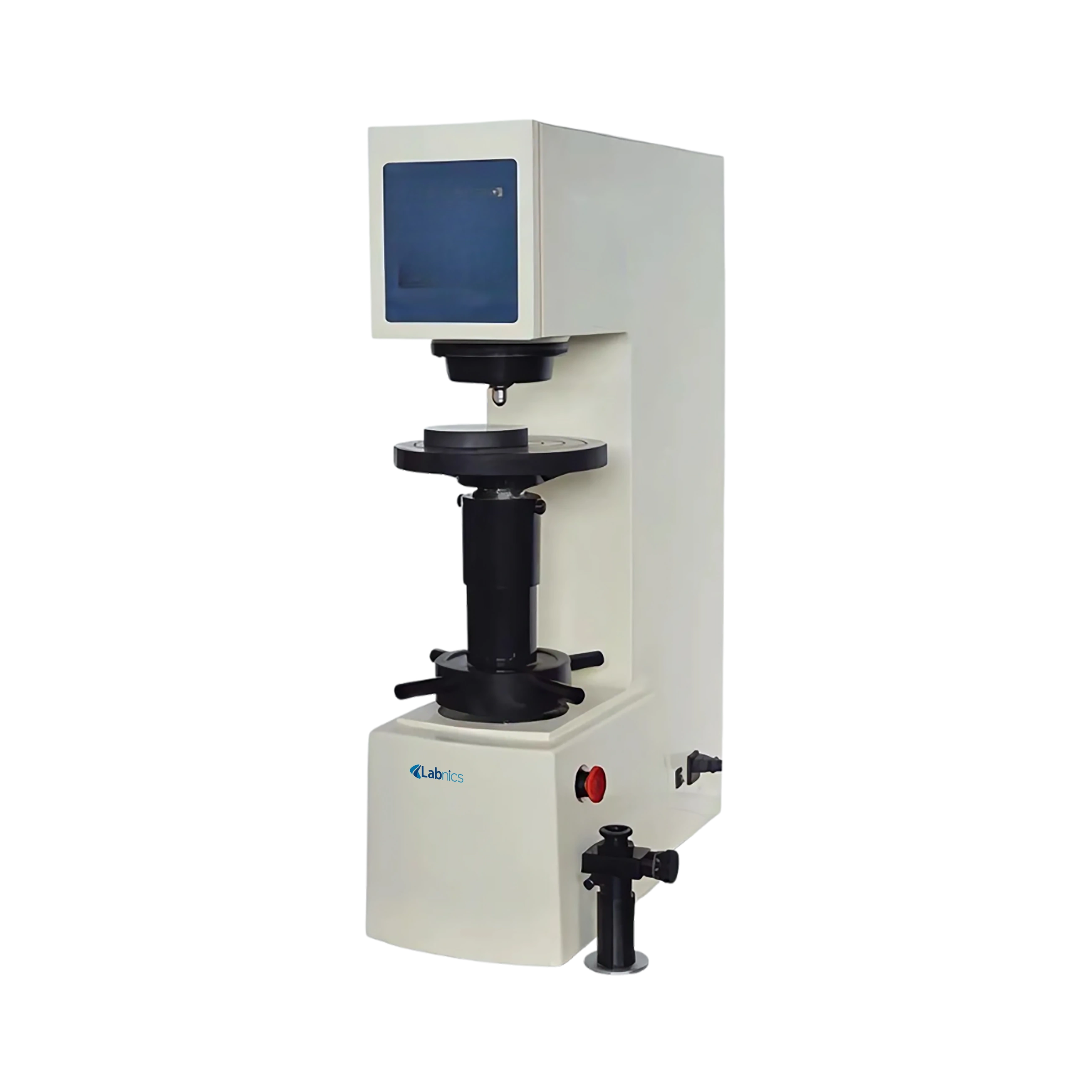
Brinell Hardness Tester NBHT-101 is used to measure the hardness of metals and alloys by determining indentation under specified loads. It is widely applied in industries such as foundries, steel plants, research laboratories, and manufacturing facilities.
FAQ for Brinell Hardness Tester NBHT-101
1: What is the test force range of the Brinell Hardness Tester NBHT-101?
The Brinell Hardness Tester NBHT-101 supports a wide range of test forces from 612.9 N (62.5 kgf) to 29420 N (3000 kgf), making it versatile for testing soft to very hard metals. This ensures adaptability for different industrial applications.
2: How accurate is the measurement system in the Brinell Hardness Tester NBHT-101?
Brinell Hardness Tester NBHT-101 is equipped with a 20× reading microscope and a 5 ?m drum wheel division, ensuring highly accurate readings. This precision makes it ideal for research labs and quality control departments.
3: What materials can be tested with this Brinell Hardness Tester NBHT-101?
The Brinell Hardness Tester NBHT-101 can test cast iron, steel, non-ferrous alloys, and heavy metal components. Its broad test force options make it suitable for both softer and harder materials.
4: Does the Brinell Hardness Tester NBHT-101 comply with international standards?
Yes, this Brinell Hardness Tester NBHT-101 executes ISO 6506, ASTM E10-12, JIS Z2243, and GB/T 231.2, ensuring global standard compliance. This makes it a trusted choice for multinational industries and laboratories.
5: What is the specimen capacity of the Brinell Hardness Tester NBHT-101?
Brinell Hardness Tester NBHT-101 supports specimens with a maximum height of 205 mm and a throat depth of 135 mm, allowing flexibility in testing different sample sizes without compromising accuracy.
6: What is the Brinell Hardness Tester used for?
The Brinell Hardness Tester is used to measure the hardness of metals and alloys by pressing a ball indenter into the material under heavy loads. It is particularly useful for testing materials with coarse or uneven structures like cast iron and non-ferrous metals.
7: What types of materials can be tested using Brinell Hardness Testers?
These testers are suitable for a wide range of metals including steel, cast iron, aluminum, copper, brass, and other alloys. They are often used in foundries, automotive, aerospace, and metallurgical industries for material quality control.
8: What is the typical test load range in Brinell Hardness Testers?
Brinell Hardness Testers usually operate with test forces ranging from 62.5 kgf to 3000 kgf, depending on the model. This allows them to test both softer materials like aluminum and harder metals such as steel and cast iron effectively.
9: How accurate are Brinell Hardness Testers?
Modern Brinell Testers are equipped with digital or touch screen displays, precision microscopes, and fine resolution drum wheels. This ensures accurate, repeatable, and reliable hardness readings that comply with ISO 6506, ASTM E10, and other global standards.
10: What industries commonly use Brinell Hardness Testing machines?
Industries such as automotive, aerospace, construction, metal fabrication, and foundries frequently use Brinell Testers. They are essential for verifying the hardness and strength of raw materials, semi-finished parts, and finished products in quality assurance processes.