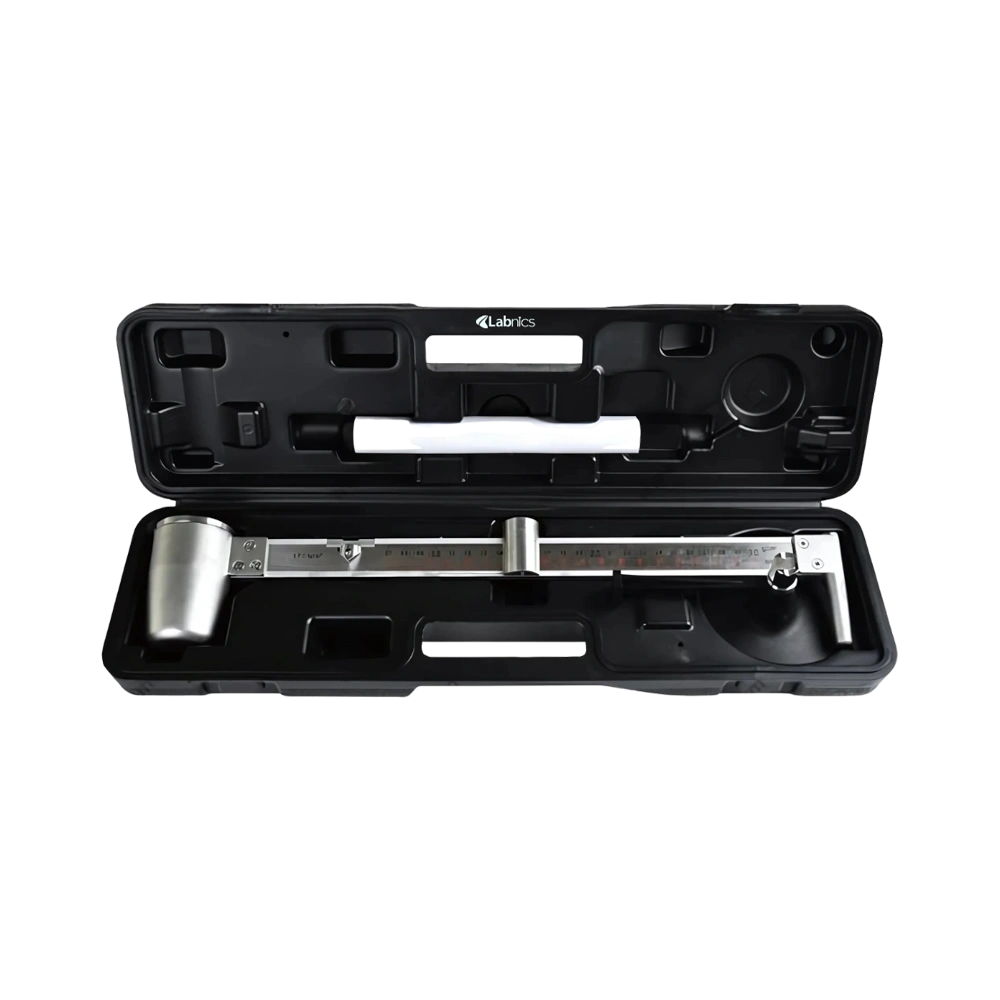
Mud Balance NMMB-100 is used to determine the density of drilling fluids and other liquid materials for process safety and performance evaluation. It is widely applied in oilfields, geological exploration sites, and research laboratories.
FAQ for Mud Balance NMMB-100
1: What is the material of Mud Balance NMMB-100?
The Mud Balance NMMB-100 is built with strong stainless steel, ensuring corrosion resistance, durability, and long-term use in both field and lab conditions without compromising measurement accuracy.
2: What measuring range does Mud Balance NMMB-100 cover?
Mud Balance NMMB-100 covers a wide range of 0.7 to 2.9 g/cm³ (5.8 to 24 lb/gal), making it suitable for diverse drilling fluids and liquid samples encountered in petroleum and geological testing applications.
3: How accurate are the readings in Mud Balance NMMB-100?
The Mud Balance NMMB-100 provides stable and consistent measurement data with minimal error. Its dual-unit readings (g/cm³ and lb/gal) ensure international usability and quick interpretation of results.
4: Where can Mud Balance NMMB-100 be used?
Mud Balance NMMB-100 is primarily used in oilfields for drilling fluid density testing but also plays a vital role in geological exploration and laboratory-based fluid analysis for academic or industrial research.
5: What makes the Mud Balance NMMB-100 user-friendly?
The Mud Balance NMMB-100 is portable, impact-resistant, and easy to calibrate. Its direct reading scale reduces operational complexity, ensuring reliable results without requiring extensive technical expertise.
6: What is a Mud Balance used for?
A Mud Balance is used to measure the density or specific gravity of drilling fluids, ensuring that the fluid weight is suitable for safe and efficient drilling operations.
7: Where are Mud Balances commonly used?
Mud Balance are widely used in oilfields, geological exploration sites, and laboratories for analyzing drilling fluid properties and liquid density.
8: How does a Mud Balance help in drilling safety?
By measuring fluid density accurately, Mud Balances help prevent blowouts, wellbore instability, and other drilling-related hazards caused by improper fluid weight.
9: Why is calibration important for Mud Balances?
Calibration ensures that the Mud Balance provides accurate readings. Regular calibration with fresh water guarantees reliability and reduces errors during drilling operations.
10: What makes Mud Balances durable for field use?
Most Mud Balances are made from strong, corrosion-resistant materials like stainless steel, making them impact-resistant and suitable for rugged field environments.