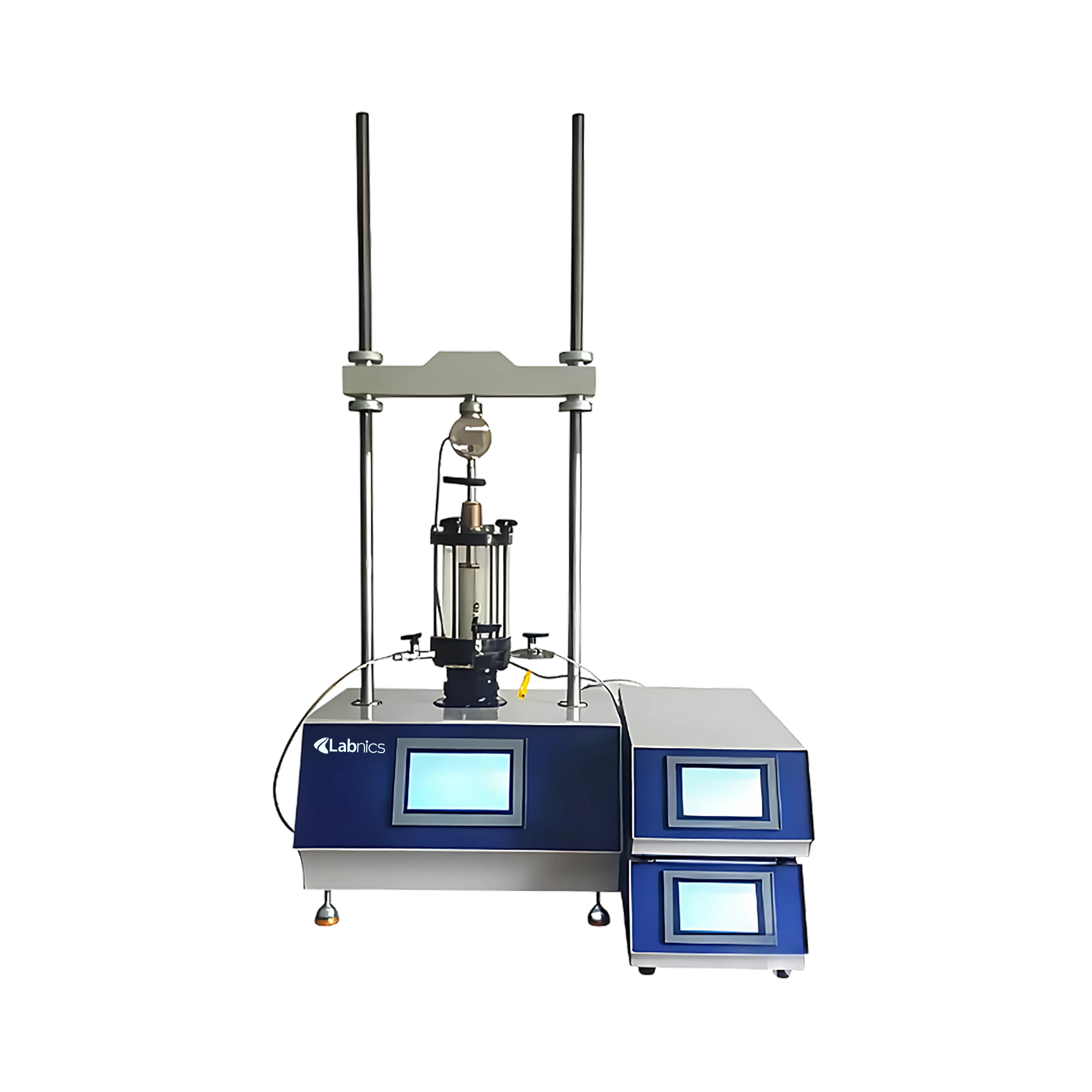
Automatic Triaxial Tester NATT-100 is used for precise measurement of soil strength and deformation properties under controlled pressure conditions. It is widely utilized in geotechnical engineering laboratories, research institutions, and universities for soil mechanics studies.
FAQ for Automatic Triaxial Tester NATT-100
1: What types of tests can the Automatic triaxial tester NATT-100 perform?
The Automatic triaxial tester NATT-100 supports multiple geotechnical test modes including saturation tests, consolidation tests, and standard UU, CU, and CD shear strength tests. This versatility makes it suitable for various soil mechanics research needs.
2: How accurate is the displacement measurement in this Automatic triaxial tester NATT-100?
Automatic triaxial tester NATT-100 offers a precision of 0.001 mm for axial load measurements, ensuring highly accurate deformation tracking. This level of accuracy is critical for obtaining reliable soil property data.
3: Can the confining pressure and back pressure be controlled independently in Automatic triaxial tester NATT-100?
Yes, the Automatic triaxial tester NATT-100 has dual independent controllers with closed-loop control for both confining and back pressures, allowing for precise and separate adjustments during testing.
4: Does the Automatic triaxial tester NATT-100 have built-in safety features?
The Automatic triaxial tester NATT-100 includes an overpressure protection function within the pressure/volume controller to safeguard both the equipment and samples during operation.
5: Is the software customizable for specific research needs in Automatic triaxial tester NATT-100?
Yes, the Automatic triaxial tester NATT-100 has multifunctional automatic test software supports personalized customization, enabling researchers to tailor test parameters and data recording formats according to project requirements.
6: What is the primary use of an Automatic Triaxial Tester?
An Automatic Triaxial Tester is used to measure the mechanical behavior of soil under simulated field stress conditions. It helps determine properties like shear strength, deformation, and consolidation, which are critical for geotechnical project design and analysis.
7: How does automation improve triaxial testing?
Automation ensures precise control of loading, pressure, and data recording during testing. This reduces human error, improves consistency between tests, and saves time in both academic and commercial geotechnical applications.
8: What testing modes can an Automatic Triaxial Tester support?
Most advanced models support multiple modes, including saturation, consolidation, and shear strength tests such as UU, CU, and CD. This versatility allows engineers and researchers to conduct comprehensive soil behavior studies in a single system.
9: Why is accurate pore pressure measurement important in triaxial testing?
Accurate pore pressure measurement ensures reliable analysis of effective stress within soil samples. This data is crucial for understanding stability and load-bearing capacity in construction and infrastructure projects.
10: In which industries is the Automatic Triaxial Tester commonly used?
It is widely used in civil engineering, geotechnical consulting firms, academic research institutions, and construction quality control laboratories. These industries rely on it for designing safe and efficient foundations, embankments, and earth structures.