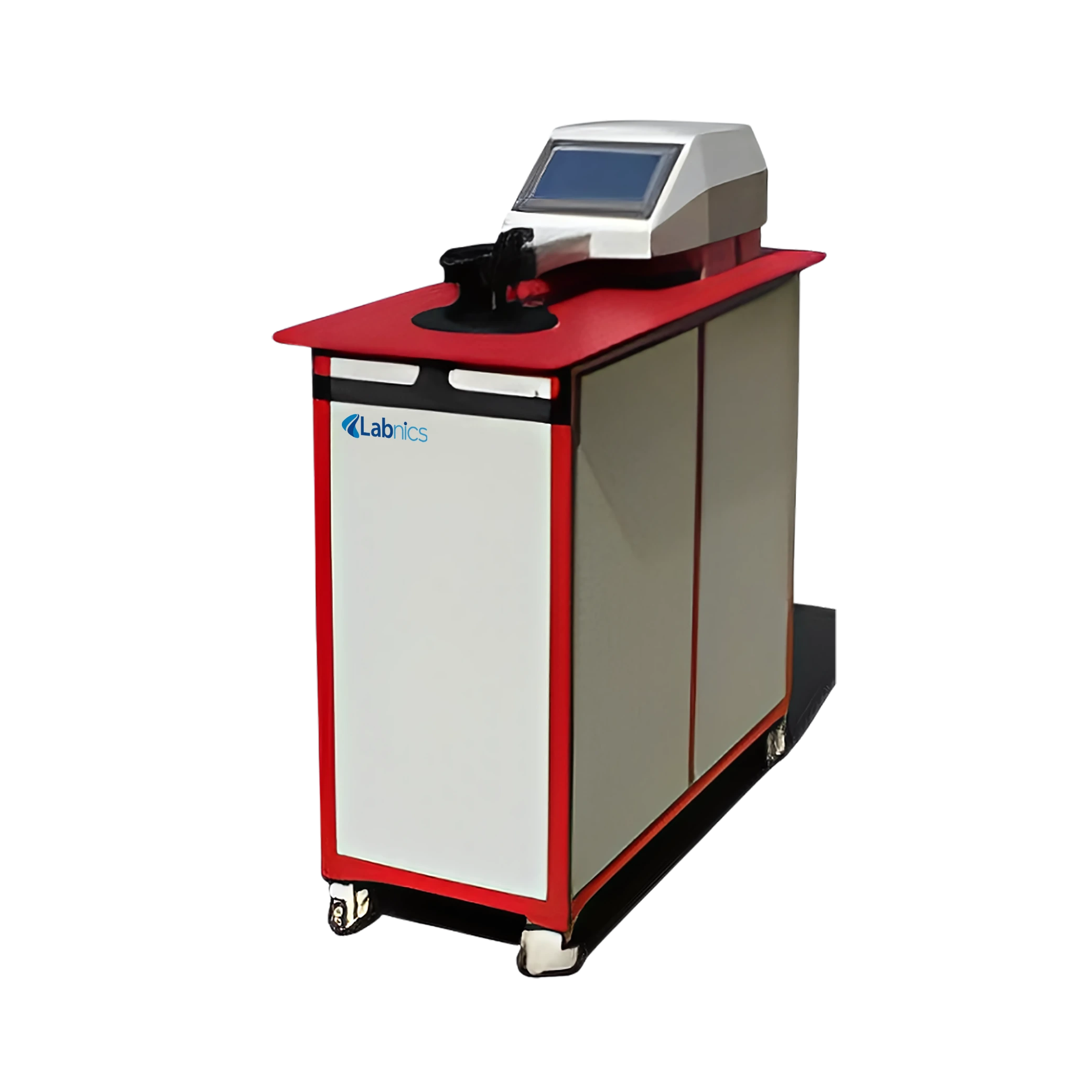
Automatic Air Permeability Tester NAAPT-100 is used to evaluate air permeability in garment fabrics and home textiles. It is used in paper and packaging industries, non-woven industry, textile and garment manufacturing.
FAQ for Automatic Air Permeability Tester NAAPT-100
1: What is the permeability range of the Automatic Air Permeability Tester NAAPT-100?
Automatic Air Permeability Tester NAAPT-100 offers a measuring spectrum from 1 to 9999 mm/s. Accuracy is maintained with an error margin of less than ±2%. This range makes it suitable for testing textiles of varied densities. It ensures precise measurement of airflow characteristics. The capability supports broad testing applications.
2: How does the nozzle system of the Automatic Air Permeability Tester NAAPT-100 function?
Automatic Air Permeability Tester NAAPT-100 features an automatic nozzle-changing system. This function eliminates the need for manual replacement. Smooth transitions allow continuous and efficient testing. The mechanism adapts quickly to different sample requirements. Automation ensures consistent and reliable results.
3: What is the maximum thickness supported by the Automatic Air Permeability Tester NAAPT-100?
Automatic Air Permeability Tester NAAPT-100 handle fabric thickness up to 12 mm. This capacity suits lightweight, medium, and heavy textile samples. Varied material construction be examined without restrictions. The flexibility expands its usability across industries. Such versatility prevents limitations during testing.
4: How does the printing system of the Automatic Air Permeability Tester NAAPT-100 work?
Automatic Air Permeability Tester NAAPT-100 comes with a thermosensitive micro printer that delivers clear and durable reports instantly. The printed records support precise documentation of test results, which be easily archived when needed. This integrated printing system ensures reliable traceability of performance data.
5: What are the power requirements of the Automatic Air Permeability Tester NAAPT-100?
Automatic Air Permeability Tester NAAPT-100 operates on AC 220V, 50/60 Hz. This standard supply is compatible with most laboratory environments. Stable energy input ensures uninterrupted functioning. Dependable voltage minimizes operational risk. Low fluctuations protect the system from errors.
6: What is an Air Permeability Tester?
An Air Permeability Tester is a laboratory equipment designed to measure how a material allows air to pass. It evaluates resistance to airflow under defined conditions. The unit ensures accurate assessment of breathability. It provides dependable results in labs and industrial use. Such a system is vital for textiles, paper, and filtration research.
7: How does an Air Permeability Tester work?
Air Permeability Tester functions by pushing air through a sample under fixed pressure. A sensor measures flow rate to produce exact readings. The collected information reflects porosity levels. A digital interface shows outcomes immediately. Advanced design includes automatic calibration for accuracy.
8: What materials can an Air Permeability Tester evaluate?
An Air Permeability Tester can assess textiles, leather, paper, and nonwoven fabric. It checks how air passes through different densities. The unit supports analysis of coated untreated materials. It provides flexibility across industrial applications. One tester adapts to many material types.
9: How accurate is an Air Permeability Tester?
The Air Permeability Tester provides precise readings under controlled conditions. Accuracy depends on calibration, sensor quality, and sample preparation. Modern units reduce operator error with automated systems. Repeatability of measurements ensures confidence. Results are reliable when the system is maintained properly.